
Worried about your child’s screen time? Let’s talk about it

Screens and childhood
Screens have become an inevitable part of modern childhood.
Our kids use them to learn, connect with friends, create art, play games, and, yes, sometimes disappear into endless YouTube videos. Schools rely on laptops. Homework is submitted online. Family members FaceTime from across the country. Technology isn't going anywhere.
And at the same time, our news stream is flooded with articles about how terrible screens are for our children’s mental health and cognitive development. Plus, it’s making everyone nearsighted.
If you're feeling conflicted about your child's digital habits, you're in good company.
Many parents are wondering where the line is between raising children who are confident with technology and raising children who know how to put it down. As a nanny agency founded around the time of the first smart phones, we’ve seen digital usage explode and parents’ thoughts about it flail in all directions.
And if there’s one thing we’ve realized, it’s this: digital use doesn’t have to be all or nothing.
Rather than aiming to eliminate screens altogether (and then failing and feeling bad about it), summer is the perfect opportunity to reset some habits and create a little more space for the offline moments that families often say they miss. Take the next few weeks to reset as a family and start the fall a little more grounded. Who knows, it might make you feel better, too.
The conversation around screens is changing
A few years ago, it felt as though more technology automatically meant better learning.
Schools across the country adopted laptops and tablets at an incredible pace, often with support from major technology companies. Digital tools opened up exciting possibilities and, in many cases, helped students continue learning during the pandemic. In an increasingly digital world, it was said, early tech literacy was key to not falling behind.
But lately, there's been a noticeable shift.
Parents, teachers, and school leaders are increasingly asking whether classrooms have become *too* dependent on screens. Some districts are reducing digital learning time, reintroducing more paper-based work, and encouraging teachers to use technology more intentionally rather than by default. The conversation has moved past, "Should kids use technology?" to "When is technology actually the best tool for learning?"
Your child needs digital skills – and real-world skills
It's important to remember that digital literacy is a genuine life skill.
Children need to know how to type, research responsibly, recognize misinformation, collaborate online, and eventually use AI thoughtfully. Those skills will serve them throughout school and well into adulthood.
But being digitally capable isn't the same thing as being digitally immersed.
Children also need opportunities to build things with their hands, solve problems without Google, make up games with friends, ride bikes until sunset, and experience the kind of boredom that often leads to creativity (keep your eyes peeled on the blog in the coming weeks for support on under-scheduling your kids, ps.).
Both skill sets matter, and as we become more and more reliant on digital solutions, those IRL-skills become even more important. It’s actually hard for kids to learn and process only with digital tools, and unlike you, they didn’t first learn the real-world skills.
How to be less screen-dependent at home
Listen, we all talk about reducing screen time – and we all know how hard it can be, for both kids and adults. But if you’ve ever scrolled too far down a rabbit hole and emerged an hour later, dazed and confused about where the time went and what you got out of it, you, too, might be feeling an urge for a little cleanse.
Here’s how to take little steps to reduce screen time, without throwing the baby out with the bathwater.
1. Replace the screen with something better
One super common mistake parents make is simply turning the tablet off and hoping for the best. If you’ve tried this, you probably remember the tantrum that came after, or the hours of incessant I don’t know what to do, I’m booooored complaints you had to hear.
If screens have been filling time, entertainment, or even comfort, it's helpful to replace them with something that scratches the same itch. Set your kiddo up with an activity, go outside together, or snuggle on the couch reading books side by side. Invite them to come help with the cooking or suggest a good old-fashioned analogue playdate. Replacing the screen with something equally or more fun will make it drift off into the forgotten land.
2. Make offline activities easy to choose
As in the examples above, the alternatives don’t have to be elaborate. With our long experience in childcare and child development, we know that one trick of engaging kids is keeping the barrier to entry as low as possible. Make it easy to choose something else.
This can be as simple as setting up your home to easily, and visually, offer:
A basket of library books at kid level
Sidewalk chalk or a soccerball by the door
A corner of the room already set up with art supplies
An enticing ingredient on the kitchen counter for cooking or baking together
Look at your own screen habits
We’re so sorry to have to do this, but we have to turn that mirror onto you, too.
If you’re anything like us, you’ve opened Instagram “real quick” and lost an hour. You’ve picked up your phone 15 times in one minute looking for a notification to beat the boredom. You’ve opted for couch time over activity because the days are exhausting and surely lying here with your phone will help you get some of your energy back.
Kids experience that same pull you do, and when they see you doing it, they figure they can, too. As a parent, you know that kids do as you do, not what you say, and that’s so true with screens.
Routines that help the whole family.
Sometimes the solution to that can be finding simple routines that make it easier for everyone in the family to put their digital devices away for a bit. Again, we’re not saying go throw your tech in the Hudson River and get all your news via messenger pigeon. Just give yourselves breaks here and there throughout the day with easy-to-follow routines.
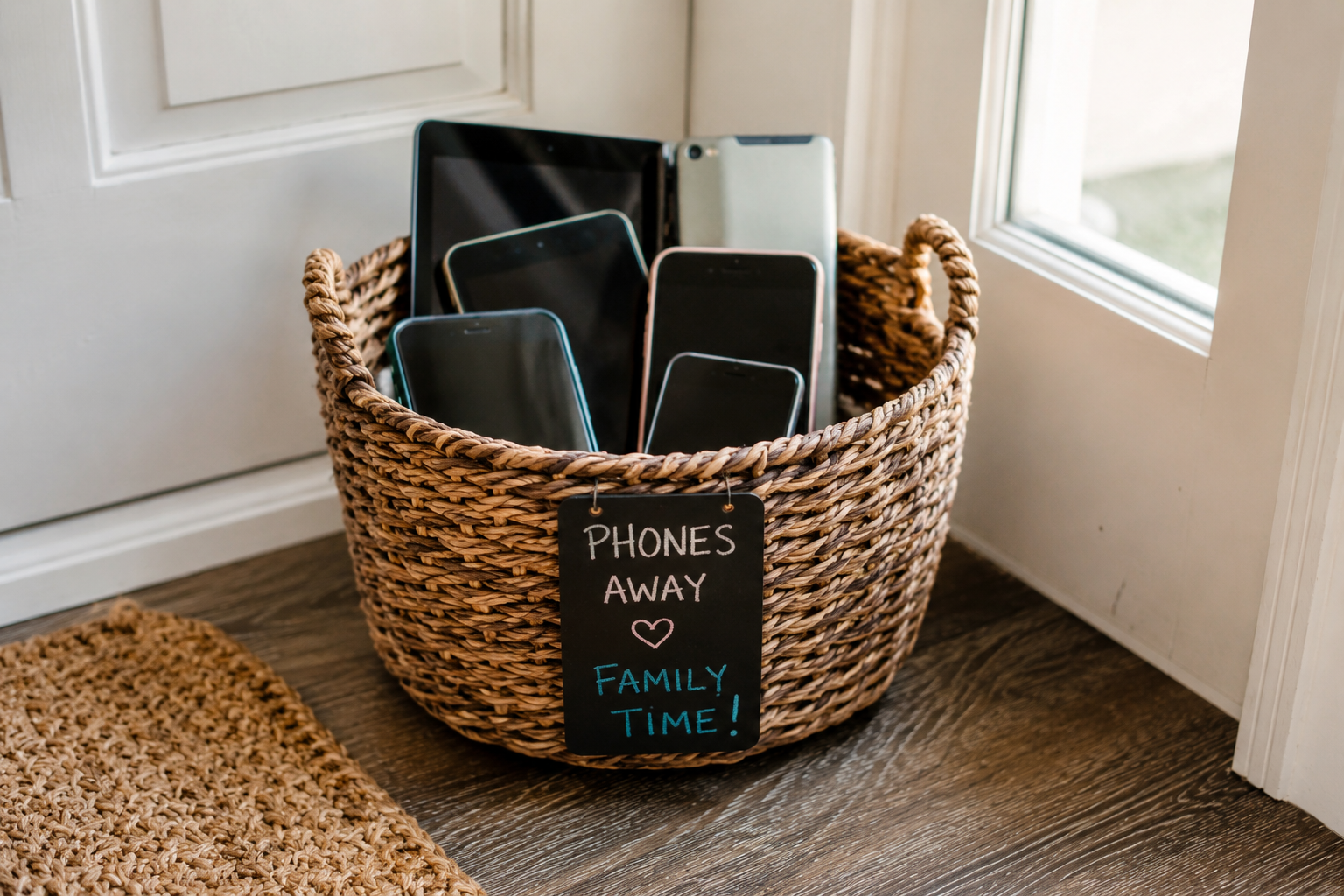
Put a screen basket by the front door: let your kids decorate the basket in fun colors, glitter, or even googly eyes and make a habit of putting the phones there when you get home or want to focus – if you have to walk to get it, you’re more likely to leave it be
Screen-free dinners or family time: meals are a great time to put phones away (including adults!), or maybe for your family it’s that after 7 pm and until tomorrow, the screens sleep in the basket, a way for everyone to connect and actually see each other
Lean into summer: away from school and with longer days, it can be easier to ignore the screens during summer – take a family walk in the evening, go for a scooter ride or bring desert to the park for a nice relaxing break (and a chance to stretch your eyes!)
A little bit goes a long way
If you take away one thing from this post, let it be this: you don’t have to be perfect about screen time, and yes it is a tricky balancing act for most of us. (Okay, that’s two!)
Just know that it’s a conversation in the zeitgeist right now, and ideally, in the future, society and schools will be helping you make it easier to reduce your kiddos screentime if that’s needed. But just doing a little bit at home to reduce an hour here, add something analogue there, or even just taking summers off from digital devices when possible, can go a long way in showing your kiddo what else is out there.
Little habits add up. And come September, maybe your kid will have opened their eyes to a lot more things past the ten-inch reach of their cell phone hold.
Smart Sitting nannies help your kids stay screen-free
Here at Smart Sitting, we have long had the conversation about screen time while nannying with the childcare providers in our network. As paid childcare professionals, they are ready to step up with screen-free activities and fun to make the most out of each shift (saving that screentime for you if you need it).
If you’re looking for a nanny or a sitter to keep your kiddo off the screen and in their best fun, reach out to us. We can help you find an as-needed babysitter, a regular after-school sitter, a full-time nanny, whatever you and your family need! Tell us a bit about yourself via the button below to get started, and a member of our team will take it from there.